
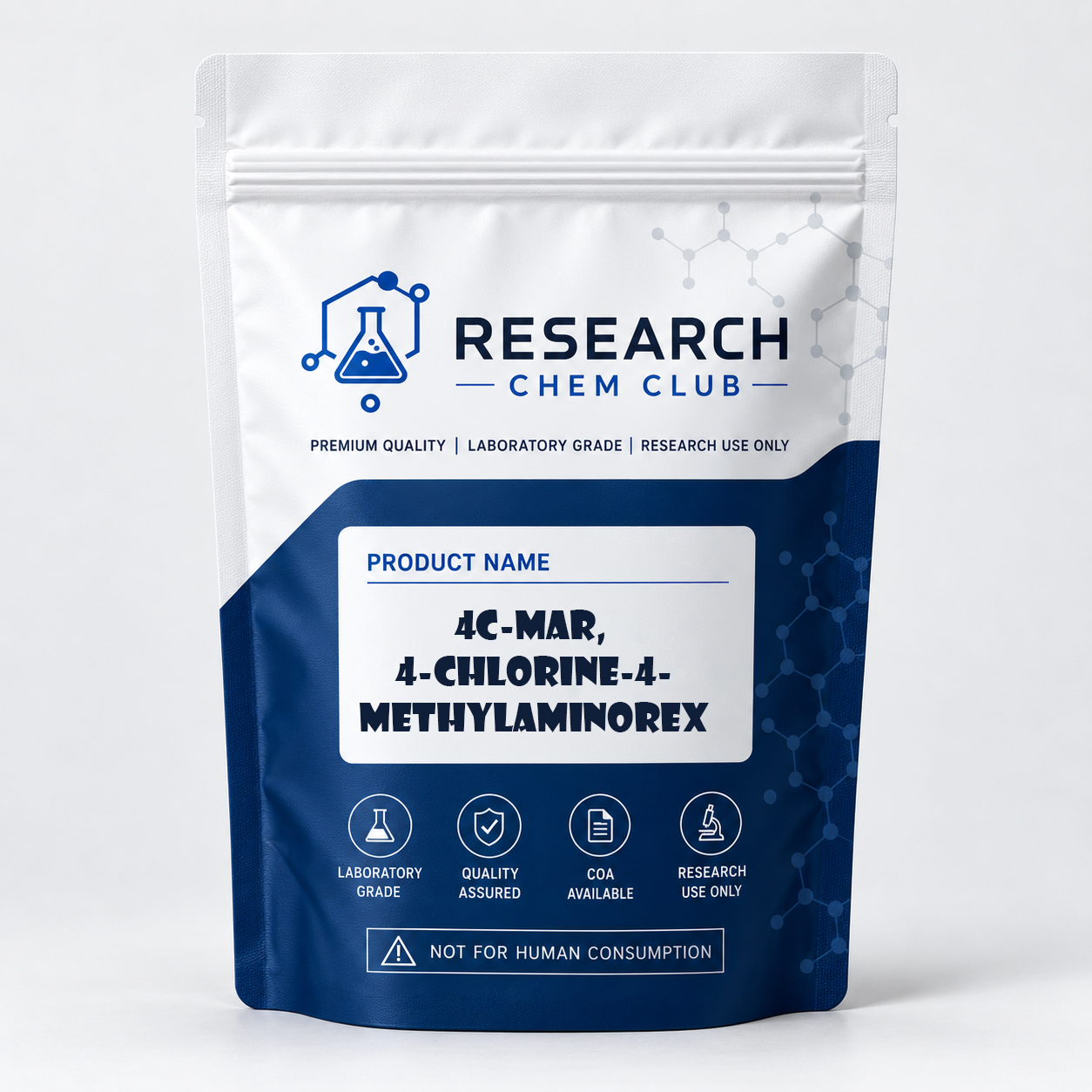
Buy 4c-Mar Online
€249.00 – €1,099.00Price range: €249.00 through €1,099.00
4C-MAR (4-Chloro-4-Methylaminorex): A Research Overview for European Laboratories
4C-MAR, also written 4-Chloro-4-Methylaminorex, is a synthetic substituted aminorex compound that appears in the scientific literature as a structural analogue within the 4-methylaminorex family. European laboratories studying designer stimulants and novel psychoactive substances encounter it mainly as a reference material for analytical method development, forensic screening, and receptor pharmacology research. This article explains what is known about the compound, how it is characterised, and the practical considerations around sourcing reference reagents in Europe.
The content below is written for research professionals: analytical chemists, forensic scientists, pharmacology researchers, and laboratory procurement staff who need accurate technical context rather than consumer-facing information. It does not provide guidance on human use, and none should be inferred.
What Is 4C-MAR (4-Chloro-4-Methylaminorex)?
4C-MAR belongs to the 4-methylaminorex (4-MAR) structural family, a group of 2-amino-5-aryl-oxazoline compounds. The “4C” designation typically signals the presence of a chlorine substituent at the para position of the phenyl ring. In nomenclature used across forensic and medicinal chemistry literature, compounds in this series are described by their ring substitution pattern combined with the parent aminorex scaffold.
The compound is best understood as a research reference standard, not a therapeutic or consumer product. Its value to laboratories lies in its role as a comparator: when unknown samples appear in forensic casework or wastewater analysis, having characterised analogues on hand speeds up identification.
How 4-Chloro-4-Methylaminorex Fits the Aminorex Family
The aminorex scaffold has drawn scientific attention since the 1960s, when the parent compound was investigated as an appetite suppressant before being withdrawn over cardiovascular safety concerns. Substituted analogues such as 4-methylaminorex and its halogenated derivatives appear in the peer-reviewed literature primarily through forensic detection studies and receptor-binding investigations.
Researchers should note that published pharmacological data specific to 4C-MAR remains limited compared with better-known analogues. Where the literature is thin, cautious language is appropriate — a principle that applies to any emerging designer compound.
Why Laboratories Study 4-Chloro-4-Methylaminorex Analogues
Analytical and forensic laboratories study substituted aminorex compounds for several interconnected reasons.
Reference standard development. Certified reference materials allow labs to build calibration curves, validate retention times, and confirm mass spectra. Without characterised analogues, identifying a novel compound in a seized sample becomes guesswork.
Method validation for screening panels. Forensic toxicology labs continually expand their targeted screening libraries. Each new analogue requires validated LC-MS/MS or GC-MS methods, and that work depends on reliable starting materials.
Structure–activity research. Medicinal chemistry groups examine how ring substitution alters receptor affinity and metabolic pathways. Comparative studies across the aminorex family help map these relationships.
Wastewater and environmental monitoring. European monitoring programmes track emerging substances in municipal wastewater. Reference standards support that surveillance work.
For laboratories building out these capabilities, sourcing research chemicals with COA documentation from a specialised supplier is a practical starting point.
Technical Profile and Analytical Characterisation
Chemical and Structural Summary
| Attribute | Detail |
|---|---|
| Compound class | Substituted 2-amino-5-aryl-oxazoline (aminorex family) |
| Common names | 4C-MAR; 4-Chloro-4-Methylaminorex |
| Ring substitution | Para-chloro on the phenyl ring |
| Typical research use | Analytical reference standard; forensic method development |
| Common analytical techniques | LC-MS/MS, GC-MS, NMR, FTIR |
Note: exact molecular weight, CAS number, and full spectral data should always be confirmed against the supplier’s certificate of analysis and primary literature before use in validated methods.
Analytical Methods Commonly Applied
Laboratories typically characterise aminorex analogues using a combination of techniques. High-performance liquid chromatography coupled with tandem mass spectrometry (LC-MS/MS) supports quantification at low concentrations. Gas chromatography–mass spectrometry remains standard for forensic screening. Nuclear magnetic resonance spectroscopy confirms structure, while infrared spectroscopy provides a rapid identity check.
Because halogenated analogues can show distinctive fragmentation patterns, analysts should verify instrument parameters against authenticated reference data rather than assuming behaviour transfers from the parent compound.
Sourcing 4C-MAR and Reference Reagents in Europe
Procurement is where research timelines are most often lost. European laboratories face a specific set of considerations: customs documentation, purity verification, and the legal status of the compound in the destination country.
Documentation to Request From Any Supplier
Before ordering, request and review the following:
- Certificate of Analysis (COA) listing purity, batch number, and analytical method used
- Third-party test results from an independent laboratory
- Safety Data Sheet (SDS) in a recognised European format
- Batch-specific spectral data where available
Suppliers offering research chemicals with COA documentation and independent third-party testing give procurement teams the audit trail that institutional compliance offices require. A reputable research chemical club or specialist vendor will provide these without hesitation.
Legal and Compliance Considerations Across Europe
This is the most important section for any European buyer. The legal status of 4C-MAR and related aminorex analogues varies by country and can change with little notice. Several European nations regulate designer stimulants through generic analogue legislation, blanket bans, or named-substance lists.
Before purchase, laboratories should:
- Verify the compound’s status under the destination country’s controlled substances legislation.
- Confirm the compound is not scheduled under relevant international conventions.
- Ensure institutional ethics and safety approvals cover the intended research use.
- Check that the supplier ships with compliant documentation.
This article cannot provide legal advice, and researchers should consult their institution’s compliance office or a qualified legal advisor. The same caution applies whether you buy research chemicals online within the EU or from UK-based suppliers.
UK and EU Supply Differences
Post-Brexit, shipments between the UK and EU involve customs declarations and, in some cases, additional import licensing. Laboratories ordering from a UK-based research chemical seller should confirm the supplier handles export paperwork correctly and that the receiving institution can accept the shipment. Buyers in the UK should consult the Psychoactive Substances Act 2016 and any relevant Misuse of Drugs legislation, while EU buyers should check national implementing rules.
For laboratories that need larger quantities for extended method-validation programmes, bulk research chemicals for sale arrangements typically require advance quotation, batch reservation, and often a minimum documentation package. Wholesale chemical synthesis reagents and bulk orders should always come with batch-specific COAs rather than generic certificates.
Choosing a Trusted Research Chemical Supplier
Supplier quality varies considerably, and the consequences of a poor choice — failed validation runs, contaminated standards, compliance problems — are costly.
What Separates Reliable Suppliers From the Rest
Trusted research chemical suppliers generally share several traits. They publish clear product specifications. They provide batch-linked COAs. They maintain transparent communication about shipping restrictions. And they respond competently to technical questions about purity and analytical methods.
Red flags include vague purity claims, refusal to share COAs before purchase, prices that seem implausibly low, and websites that read more like consumer shops than laboratory suppliers.
Practical Buying Checklist
Use this checklist before committing to any order:
- Confirm COA availability and that it matches the specific batch
- Ask whether third-party testing was performed and by whom
- Verify the supplier’s shipping policy for your country
- Check lead times against your project timeline
- Confirm packaging meets your institution’s receiving requirements
- Request a sample or small quantity for method-development trials first
Laboratories also frequently need high purity chemical indicators shop stock for related analytical work; consolidating suppliers where possible reduces administrative overhead. A well-organised supplier such as Research Chem Club can serve both roles.
Handling, Storage, and Laboratory Safety
Standard good laboratory practice applies to 4C-MAR as to any synthetic reference material. Store compounds in sealed, labelled containers under conditions specified by the supplier — typically cool, dry, and protected from light. Maintain a controlled-access inventory log.
Because published toxicological data for this specific analogue is limited, handling precautions should be conservative: gloves, eye protection, fume extraction where appropriate, and avoidance of dust generation during weighing. Researchers should treat the compound as a potential hazard until adequate data says otherwise.
Responsible Research Practice and Emerging Compound Monitoring
Emerging designer compounds move faster than legislation, which places a professional obligation on laboratories. Publishing validated analytical methods, sharing spectral data with monitoring networks, and reporting findings through established channels all strengthen the wider research ecosystem.
European researchers benefit from coordinated surveillance through national early-warning systems. Contributing characterised reference data to these networks improves collective identification capability and supports public health responses.
Frequently Asked Questions
What is 4C-MAR? 4C-MAR (4-Chloro-4-Methylaminorex) is a substituted aminorex compound used in laboratory research as an analytical reference standard. It belongs to the 4-methylaminorex structural family and carries a para-chloro ring substituent.
Is 4C-MAR legal to buy in Europe? Legality depends entirely on the destination country’s legislation, and many European nations regulate designer stimulants through analogue or blanket legislation. Researchers must verify national rules and confirm institutional compliance before ordering. This article is not legal advice.
What documentation should accompany a 4C-MAR order? A batch-specific certificate of analysis, third-party test results where available, a safety data sheet, and spectral data for identity confirmation. Reputable suppliers provide these before purchase.
Can laboratories buy research chemicals online safely? Yes, provided the supplier demonstrates verifiable documentation, transparent specifications, and compliant shipping. Laboratories should request COAs in advance and start with small trial quantities.
What analytical techniques identify 4C-MAR? LC-MS/MS, GC-MS, NMR, and FTIR are the standard techniques. Confirm exact parameters against authenticated reference data and the supplier’s COA.
How should 4C-MAR be stored? Store sealed, labelled, and protected from light in cool, dry conditions per the supplier’s instructions, with controlled inventory access and appropriate personal protective equipment during handling.
Where can European laboratories find trusted suppliers? Look for vendors that publish batch-linked COAs, maintain clear shipping policies, and answer technical questions directly. Institutional procurement teams can also request references from peer laboratories.
| Quantity | 10g, 25g, 50g, 100g |
|---|
Only logged in customers who have purchased this product may leave a review.

Reviews
There are no reviews yet.