
Uncategorized
How to Read a Research Chemical Safety Data Sheet in Europe
Oct
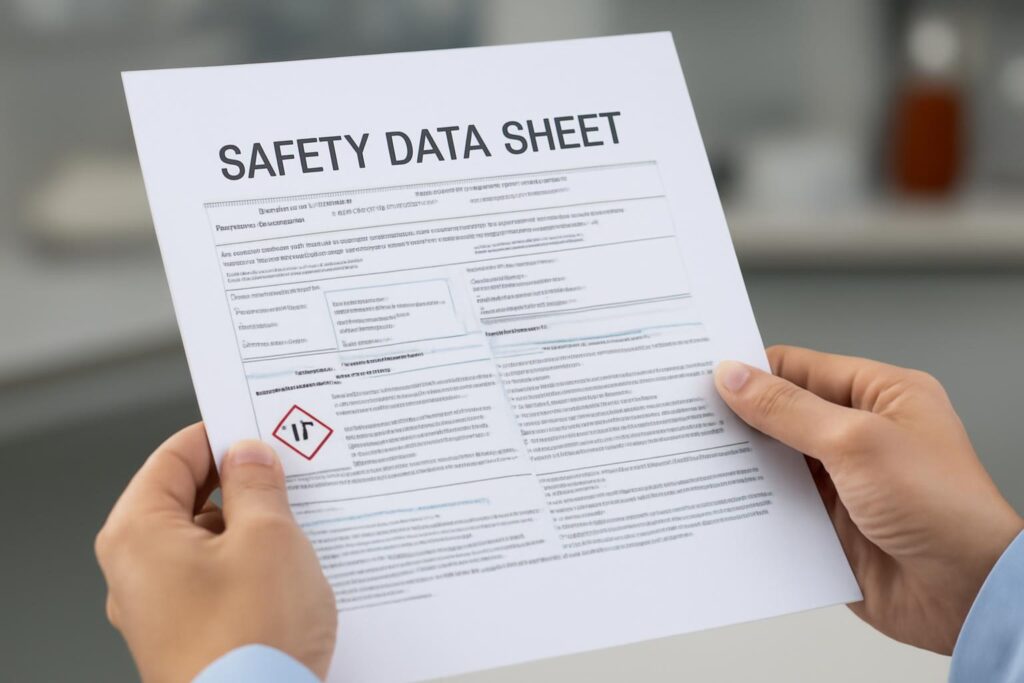
A safety data sheet, usually called an SDS, is one of the most useful documents for evaluating a chemical before it enters a laboratory or professional workplace. For research chemicals, it is especially important because published toxicology may be limited, product names can vary, and a label alone rarely provides enough information for a proper risk assessment.
This guide explains how to read a research chemical SDS in Europe and how to use its information responsibly. It is intended for laboratories, universities, analytical facilities, and qualified professionals. An SDS is not a guarantee that a substance is safe, legal, or suitable for human use. It is a hazard communication document that supports—not replaces—a site-specific assessment by a competent person.
What is a safety data sheet?
An SDS is a standardised document describing the hazards, handling requirements, emergency measures, and regulatory information associated with a chemical or mixture. In the European Economic Area, SDS documents are generally prepared within the framework of the REACH chemicals regulation and the Classification, Labelling and Packaging (CLP) Regulation, although responsibilities and requirements can vary according to the substance, supplier, intended use, and jurisdiction.
A typical SDS contains 16 sections. The headings are consistent, but the quality and completeness of individual documents can differ. A professional user should check whether the document is current, whether it identifies the material clearly, and whether it reflects the actual product supplied.
Start with identity and document control
Section 1: Identification of the substance and supplier
The first section should state the product name, relevant identified uses, restrictions on use, supplier details, and an emergency telephone number. Compare the product name and any identifier in the SDS with the container label, purchase documentation, and internal records.
Pay attention to vague descriptions such as “laboratory material” or “research use only.” These phrases do not explain the substance’s toxicology or establish that a proposed activity is lawful. If the material has a CAS number, EC number, systematic chemical name, or another reliable identifier, record it. If the identity is uncertain, pause the work until the discrepancy has been resolved.
Document version and revision date
Look for the issue date, revision number, and any indication of what changed. An old SDS may omit newer hazard classifications or updated emergency information. Laboratories should maintain a controlled SDS inventory and review documents when a new batch, formulation, supplier, or intended use is introduced.
For general orientation, readers can browse the Research Chem Club information hub, but product pages and marketing descriptions should never replace the current SDS or a qualified laboratory assessment.
Understand the hazard classification
Section 2: Hazards identification
This section provides the fastest overview of the main hazards. It may include a signal word, hazard pictograms, hazard statements, and precautionary statements.
- Signal words: “Danger” indicates a more severe hazard category than “Warning.”
- Hazard pictograms: These communicate risks such as acute toxicity, corrosion, flammability, oxidising properties, environmental hazards, or serious health effects.
- Hazard statements: These describe the type of harm, for example harmful if swallowed, causes serious eye damage, or may cause respiratory irritation.
- Precautionary statements: These cover prevention, response, storage, and disposal.
The absence of a pictogram does not prove that a research chemical is harmless. Some substances lack sufficient data for a complete classification, while others may present hazards that are not captured by a simple label. Unknown or incomplete toxicology should be treated as uncertainty requiring additional controls—not as evidence of low risk.
Check the composition and concentration
Section 3: Composition or information on ingredients
Section 3 identifies the substance or ingredients in a mixture and may provide concentration ranges. For a single compound, verify that the chemical name and identifier match the material received. For a formulation, examine whether solvents, stabilisers, salts, or other components contribute additional hazards.
Concentration ranges can affect classification and control measures. A product described as a “solution” should not be assessed in the same way as a neat compound. Similarly, a powder, solution, tablet, blotter, or other physical presentation can change exposure pathways even when the active chemical is nominally the same.
If the composition is undisclosed, inconsistent, or materially different from the label, do not assume that the SDS applies. Quarantine the container and ask the responsible safety officer or supplier for clarification.
Use toxicological information carefully
Section 11: Toxicological information
This section may describe routes of exposure, symptoms, acute effects, chronic effects, sensitisation, carcinogenicity, reproductive toxicity, and target-organ effects. For many research chemicals, however, human data may be limited or absent.
Terms such as “no data available,” “not classified,” or “data not available for this endpoint” have specific practical meaning. They do not mean that the substance has been shown to be safe. They mean that the available information is insufficient for a conclusion or classification under the relevant framework.
Consider all plausible routes of exposure:
- Inhalation: Dusts, aerosols, vapours, and volatile solvents can enter the respiratory system.
- Skin contact: Some chemicals cross damaged skin or are transferred from contaminated gloves and surfaces.
- Eye contact: Splashes and airborne particles can cause local injury or systemic exposure.
- Ingestion: Contaminated hands, food, drinks, or equipment can create an avoidable route of exposure.
- Injection or intentional consumption: These are not legitimate laboratory handling routes and can create severe or unpredictable toxicity.
Do not use an SDS to estimate a recreational dose, a “safe” amount, or a human-effect threshold. An SDS cannot validate human consumption, and research status does not make an unapproved compound suitable for medical or personal use.
Interpret first-aid and emergency instructions
Section 4: First-aid measures
Read the first-aid section before beginning work. It normally explains actions for inhalation, skin contact, eye contact, and ingestion, along with the most important symptoms and whether immediate medical attention is required.
For an exposure, remove the person from danger without creating a second casualty. Flush affected eyes or skin with clean running water when appropriate, remove contaminated clothing, and seek professional medical advice. Do not induce vomiting unless specifically instructed by a medical professional or poison centre.
Keep the product container, label, SDS, and exposure details available for clinicians. Useful information includes the chemical identity, approximate amount, route of exposure, time of exposure, symptoms, and any co-exposures. In an emergency in the European Union, call 112 or the relevant national emergency number. Poison centre arrangements differ between countries, so workplaces should maintain local contact details in advance.
Section 5: Fire-fighting measures
This section identifies suitable extinguishing media, hazardous combustion products, and protective equipment for emergency responders. A chemical that is not itself highly flammable may still be stored with flammable solvents or packaging. Review the entire storage setup rather than considering the active substance in isolation.
Assess exposure controls and personal protective equipment
Section 8: Exposure controls and personal protection
Section 8 is central to day-to-day laboratory planning. It may list occupational exposure limits, biological monitoring guidance, engineering controls, respiratory protection, glove materials, eye protection, and protective clothing.
For many novel or poorly characterised compounds, no occupational exposure limit exists. In that situation, the absence of a limit should lead to a precautionary approach. Use the hierarchy of controls:
- Eliminate or substitute: Avoid unnecessary work or use a less hazardous alternative where scientifically appropriate.
- Engineering controls: Use suitable local exhaust ventilation, fume cupboards, enclosures, or closed transfer systems.
- Administrative controls: Restrict access, document procedures, train staff, and limit quantities.
- Personal protective equipment: Select gloves, eye protection, laboratory clothing, and respiratory protection based on the actual task.
Gloves are not universally protective. Permeation depends on the chemical, glove material, thickness, contact time, and temperature. Check manufacturer compatibility data and change gloves promptly if contaminated or damaged. Respirators should not be treated as a substitute for effective ventilation and require appropriate fit testing and maintenance.
Review handling, storage, and accidental release measures
Sections 6 and 7: Accidental release and handling
Section 6 describes precautions for spills, environmental protection, containment, and clean-up. Section 7 addresses safe handling and storage, including incompatible materials and conditions to avoid.
Before work begins, determine:
- Whether the substance forms dust or vapour;
- Whether it reacts with water, acids, bases, oxidisers, heat, or light;
- Whether it requires secondary containment or restricted access;
- Which absorbent or clean-up method is compatible;
- How contaminated waste will be packaged and labelled;
- How an exposure or spill will be reported internally.
Never improvise spill procedures for an unfamiliar compound. A small quantity can still create a serious exposure if it is highly potent, readily airborne, or difficult to decontaminate. If the material’s properties are uncertain, isolate the area and contact trained safety personnel.
Check stability, transport, and disposal information
Sections 9, 10, 13, and 14
Physical and chemical properties in Section 9 can include appearance, odour, pH, melting point, vapour pressure, solubility, and flammability. Missing values are common for emerging substances, but missing information can affect risk controls. Do not infer stability or volatility from colour, texture, or a product name.
Section 10 covers stability and reactivity. It may identify hazardous reactions, conditions to avoid, and incompatible materials. Section 13 addresses disposal, while Section 14 provides transport information. Disposal and transport duties can depend on national rules, waste classification, packaging, and quantity.
Do not pour research chemicals into sinks or place them in ordinary rubbish unless a competent waste professional has confirmed that this is permitted. Maintain waste labels and use an authorised route appropriate to the material and jurisdiction.
Where useful, the site’s product index can help locate product records, while the site information index provides a broader route to available pages. Neither index replaces a current SDS, national waste guidance, or institutional approval.
Common warning signs of an unreliable SDS
Approach an SDS cautiously when it:
- Uses a product nickname without a clear chemical identity;
- Contains contradictory names, identifiers, or concentrations;
- Has no revision date, supplier details, or emergency contact;
- Copies generic wording without substance-specific information;
- Claims that a compound is completely safe or risk-free;
- Provides human-use instructions despite being described as a research material;
- Does not match the container label or supplied batch;
- Omits relevant hazards while making unusually strong purity claims.
A questionable SDS does not automatically prove that a material is dangerous, but it does mean that the uncertainty must be managed. Ask for clarification, consult a qualified chemist or occupational hygienist, and do not proceed with unapproved work.
Build an SDS-based laboratory checklist
A practical review can be recorded in a short checklist:
- Confirm the substance identity, batch, label, and SDS revision.
- Identify all hazard pictograms, signal words, and hazard statements.
- Record known and unknown toxicological endpoints.
- Map possible exposure routes for the planned task.
- Select engineering controls and compatible PPE.
- Confirm storage segregation, access controls, and quantity limits.
- Prepare spill, exposure, fire, and waste procedures.
- Check transport, import, export, and national legal requirements.
- Obtain approval from the responsible safety professional before work begins.
Frequently asked questions
Does an SDS prove that a research chemical is legal in Europe?
No. An SDS communicates hazards and handling information. Legal status can depend on EU rules, national controlled-substance laws, customs requirements, workplace regulations, intended use, and whether the material is authorised for a particular application.
What does “research use only” mean?
It generally indicates that the material is not being supplied as a food, medicine, cosmetic, or approved consumer product. It is not a safety certification and does not authorise human consumption or bypass applicable laws.
Can I rely on a product description instead of an SDS?
No. Marketing copy may be incomplete or focused on commercial features. Risk assessment should use the current SDS, verified identity information, institutional procedures, and advice from a competent professional.
What should I do if the SDS is missing?
Do not begin work until the material has been identified and appropriate hazard information is available. Quarantine the container and contact the responsible laboratory manager, safety officer, or supplier.
Final takeaway
Reading a research chemical SDS is not a formality. It is a structured way to identify uncertainty, plan controls, prepare for emergencies, and decide whether a proposed activity should proceed at all. In Europe, users must also consider national implementation of chemical, workplace, waste, transport, and controlled-substance rules.
The safest approach is conservative: verify identity, treat missing data as uncertainty, avoid human use, limit quantities, use appropriate engineering controls, and involve a qualified safety professional. Good documentation cannot remove every risk, but it can prevent avoidable exposures and support more responsible laboratory practice.
