Uncategorized
Nitazenes in Europe: Why Synthetic Opioids Are a Growing NPS Concern
Oct
Nitazenes in Europe have become an important public-health concern because these synthetic opioids can be exceptionally potent, difficult to identify, and sometimes sold as other substances. Their appearance illustrates a wider challenge associated with novel psychoactive substances: products can change faster than laboratory data, clinical guidance, and national legislation.
This article explains what nitazenes are, why they matter, how opioid toxicity develops, and what laboratories, healthcare professionals, researchers, and the public should understand about the risks. It is educational information only. Nitazenes are not suitable for self-experimentation, and unknown powders, tablets, or liquids should never be handled or consumed casually.
What are nitazenes?
Nitazenes are a family of synthetic opioids derived from the benzimidazole opioid structure. The group includes several different compounds, and their effects can vary according to molecular structure, concentration, formulation, and the presence of other substances. Some nitazenes have demonstrated very strong activity at the mu-opioid receptor, the main receptor responsible for opioid analgesia, sedation, respiratory depression, and euphoria.
The term “nitazene” does not describe one single chemical. It refers to a chemical family that may include compounds with different potency and pharmacological profiles. This distinction is essential: knowing that a sample is associated with the nitazene family does not, by itself, establish its identity, concentration, purity, or likely clinical effect.
As with other emerging psychoactive substances, names used in online listings, packaging, or informal discussion may be inaccurate. A tablet or powder marketed under a familiar pharmaceutical name may contain a nitazene, another opioid, a mixture of substances, or no reliably identified active ingredient at all.
Why are nitazenes appearing in Europe?
Several market forces can contribute to the emergence of synthetic opioids. When established drugs become harder to obtain, manufacturers may seek compounds that are inexpensive to produce, easy to transport, or not yet covered by a specific national control measure. A newly identified substance may also be marketed before toxicological information is available.
In Europe, the situation is complicated by differences between national drug laws, varying laboratory capacity, and the speed of online distribution. A compound can be detected in one country while remaining unfamiliar to clinicians or forensic laboratories elsewhere. Products may also move across borders in small consignments, making their distribution difficult to monitor.
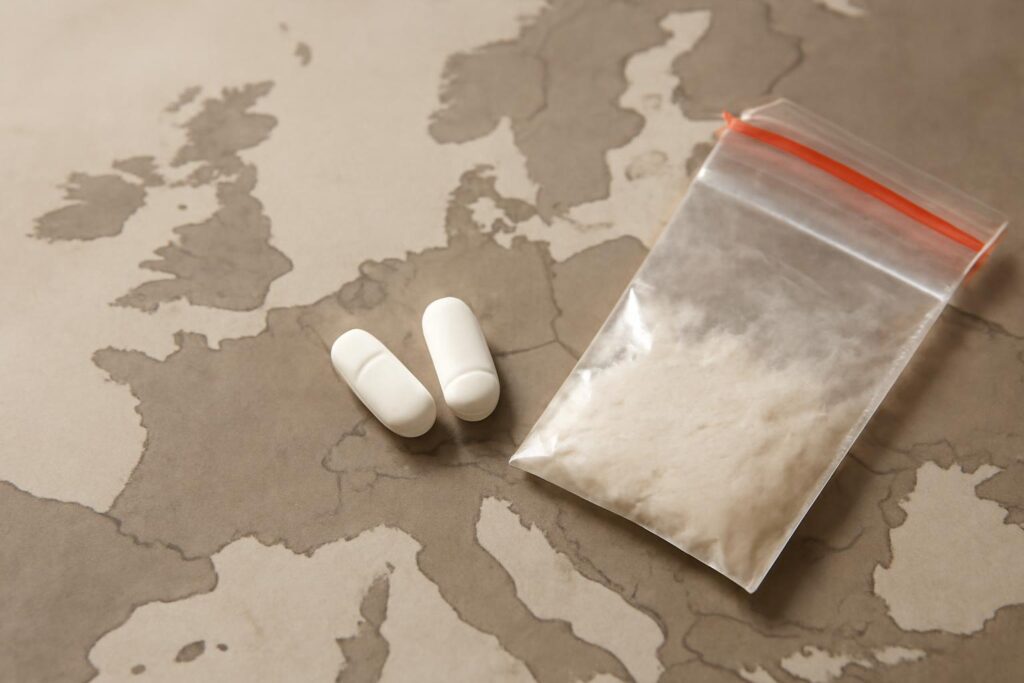
Nitazenes may be encountered as powders, tablets, capsules, or liquids. They can be misrepresented as prescription opioids or other medicines. This creates a particular danger because a person may believe they are taking a known dose of a familiar medicine when the actual contents are unknown and potentially much more potent.
How do nitazenes affect the body?
Most clinically significant nitazene effects are linked to activation of mu-opioid receptors in the central nervous system. This can reduce pain perception and produce sedation, but it can also suppress the brain’s response to rising carbon dioxide. Breathing may become slower, shallower, or irregular. In severe poisoning, respiratory arrest can occur.
Other possible opioid effects include:
- drowsiness, confusion, or loss of consciousness;
- pinpoint pupils, although this sign is not always present;
- nausea and vomiting;
- weakness, dizziness, or poor coordination;
- low blood pressure and a slow heart rate;
- cold, clammy, or bluish skin when oxygen levels fall; and
- coma, respiratory failure, and death.
The timing and severity of effects can be unpredictable. A person may initially appear merely sleepy before deteriorating quickly. Other ingredients, including alcohol, sedatives, stimulants, or additional opioids, can make the clinical picture more complicated and increase the likelihood of fatal respiratory depression.
Why nitazene toxicity can be difficult to recognise
There is no dependable way to identify a nitazene from colour, texture, tablet markings, packaging, or a seller’s description. Even a product that looks identical to a pharmaceutical tablet may contain a different substance. Visual inspection cannot establish chemical identity or potency.
Routine toxicology testing may also fail to detect some emerging opioids unless the laboratory uses suitable analytical methods and reference standards. A negative initial screen does not necessarily rule out opioid poisoning. Clinical assessment and emergency treatment should never be delayed while waiting for definitive laboratory confirmation.
Another challenge is the variation between batches. Two samples carrying the same name may contain different compounds or concentrations. Uneven distribution in a powder or tablet can also mean that one portion contains far more active material than another. This is one reason why informal dose comparisons are unsafe and why data from one sample cannot reliably predict the effects of another.
Recognising a possible opioid overdose
Suspected opioid poisoning is a medical emergency. Warning signs may include a person who cannot be woken, breathing fewer than normal breaths, unusual snoring or gurgling, limpness, blue or grey lips, pale or clammy skin, vomiting while unconscious, or no response to voice and touch.
If an overdose is suspected in Europe, call the local emergency number immediately. Place the person on their side if they are breathing but unconscious, keep the airway clear, and remain with them. If they are not breathing normally, follow the emergency dispatcher’s instructions and begin resuscitation if trained to do so.
Naloxone can rapidly reverse opioid-related respiratory depression, although its duration of action may be shorter than the effects of some synthetic opioids. A person may become unresponsive again after initially improving. Emergency medical assessment is therefore still necessary, even when naloxone appears to work.
Do not induce vomiting, place an unconscious person in a bath or shower, or assume that someone who wakes up is safe. Avoid giving food, drink, or other substances to a person who is drowsy or unable to swallow normally.
Risk factors that increase the danger
Nitazene-related harm is not determined only by the chemical itself. Several factors can increase the risk of severe poisoning:
- Unknown identity: the product may contain a different opioid or multiple substances.
- Variable potency: small differences in concentration may produce very different effects.
- Loss of opioid tolerance: tolerance can fall after a period without opioid exposure.
- Polysubstance use: alcohol, benzodiazepines, sedating medicines, and other depressants can compound respiratory depression.
- Underlying illness: respiratory, cardiac, liver, or neurological conditions may increase vulnerability.
- Using alone: nobody may be present to call for help or provide emergency support.
- Delayed recognition: symptoms may be mistaken for sleep, intoxication, or fatigue.
These factors also matter in clinical and forensic investigations. A toxicology result should be interpreted alongside the history, physical findings, scene information, and any available product or packaging evidence.
Nitazenes and the research-chemical market
The phrase “research chemical” can refer to a compound supplied for analytical, pharmacological, or laboratory investigation. It does not mean that a substance is safe, approved for human use, or legal in every European country. In particular, a research label cannot validate an unknown opioid or provide a reliable indication of its toxicity.
Professional laboratories should treat suspected nitazene materials as high-risk unknowns. Work should be conducted only under an appropriate institutional risk assessment, with competent personnel, suitable containment, exposure controls, validated analytical procedures, and documented waste management. Unnecessary handling, transfer, or re-packaging should be avoided.
Organisations developing internal procedures may find it useful to review the research chemical safety FAQs alongside their own occupational-health, chemical-hygiene, and emergency-response requirements. General online information cannot replace a site-specific assessment or professional advice.
Analytical identification and toxicology
Reliable identification normally requires specialist instrumental analysis. Depending on the purpose of the investigation, laboratories may use techniques such as liquid chromatography coupled with mass spectrometry, gas chromatography–mass spectrometry, high-resolution mass spectrometry, or nuclear magnetic resonance spectroscopy. Reference materials and quality controls are important when confirming an uncommon compound.
Screening and confirmation are different activities. A broad screening method may indicate the presence of an opioid-like substance, while a confirmatory method aims to establish the specific compound and, where possible, its concentration. Laboratories should document limitations, including compounds not covered by the method and the possibility of matrix effects or degradation.
For workplaces and research settings, the safest approach is prevention: restrict access, maintain accurate inventories, label materials clearly, use appropriate protective equipment, and have a written incident plan. Information about a product’s origin should not be treated as proof of composition.
How Europe is responding
European responses to nitazenes generally combine early-warning systems, forensic monitoring, clinical alerts, drug-control measures, and public-health communication. National approaches can differ, but the underlying challenge is shared: new compounds may appear before sufficient evidence exists about their potency, metabolism, long-term effects, and interactions.
Legislation may control individual compounds, groups of related substances, or broader categories. A substance’s legal status can therefore change quickly and may differ between countries. Cross-border research, transport, possession, and disposal require careful review of the relevant national rules. Businesses and institutions should obtain legal and regulatory advice rather than relying on a product description or a supplier’s claim.
For organisations evaluating a supplier or laboratory partner, the information about research chemical operations should be considered alongside independent due diligence, documentation checks, and applicable European requirements. No commercial page can substitute for regulatory review or analytical verification.
Practical harm-reduction messages
The most effective safety message is simple: do not consume unknown powders, tablets, or liquids, and do not assume that a product is safe because it is sold online or labelled for research. Avoid combining opioids with alcohol, benzodiazepines, sleep medicines, or other sedatives. Keep potentially hazardous materials away from children, pets, and anyone who could mistake them for medicines or supplements.
People who use opioids should know the signs of overdose and understand how to access emergency services and naloxone where it is legally available. Friends and family can reduce harm by learning basic first aid, staying alert to slowed breathing, and responding promptly rather than waiting for symptoms to resolve.
Healthcare professionals should ask about possible exposure to unknown or counterfeit medicines when opioid toxicity is suspected. A patient’s account may be incomplete because the product was mis-sold, the person is unconscious, or fear of legal consequences limits disclosure. A non-judgemental approach can improve the quality of information and speed up treatment.
Frequently asked questions
Are nitazenes the same as fentanyl?
No. Nitazenes and fentanyl are different chemical families, although both can include highly potent synthetic opioids that activate mu-opioid receptors. Their individual potency, duration, metabolism, and detectability vary by compound.
Can you identify a nitazene by looking at it?
No. Colour, powder texture, tablet shape, logos, and packaging cannot establish chemical identity or concentration. Reliable identification requires appropriate laboratory analysis.
Are nitazenes legal in Europe?
There is no single answer for every country or compound. European nations apply national laws and may control individual substances, chemical groups, or broader categories. Anyone handling or transporting a suspected nitazene should obtain current advice for the specific jurisdiction.
Can naloxone reverse nitazene poisoning?
Naloxone may reverse opioid-related respiratory depression, but repeated doses and prolonged monitoring may be needed. Emergency services should always be contacted because symptoms can return after an initial improvement.
Why are nitazenes important for research laboratories?
They demonstrate how quickly a high-risk compound can enter circulation before comprehensive toxicological data are available. Laboratories need strong identification methods, controlled access, clear documentation, and procedures for unknown high-potency materials.
Key takeaway
Nitazenes in Europe represent a serious example of the risks created by rapidly evolving synthetic opioids. Their variable identity, potentially high potency, uncertain contents, and difficult detection can turn an apparently familiar product into a life-threatening exposure. Education, early recognition of overdose, prompt emergency response, robust laboratory controls, and up-to-date legal awareness are central to reducing harm.
For broader background on responsible research-chemical information and laboratory-focused practice, readers can visit the Research Chem Club home page. Any decision involving a suspected nitazene should be guided by qualified toxicologists, occupational-safety professionals, healthcare providers, and the relevant national authorities.
